Boom Lift vs Scissor Lift in Dubai: Which Machine Is Right for Your Job?
If you have ever requested an aerial work platform in Dubai and been asked whether you need a boom lift or a scissor lift, you are not alone. The two machines look completely different, work very differently, and suit completely different jobs — but the names are often used interchangeably, causing confusion and sometimes the wrong machine arriving on site. This guide explains exactly how each machine works, what each one is designed to do, and the specific questions to ask before you decide which one your Dubai project actually needs.
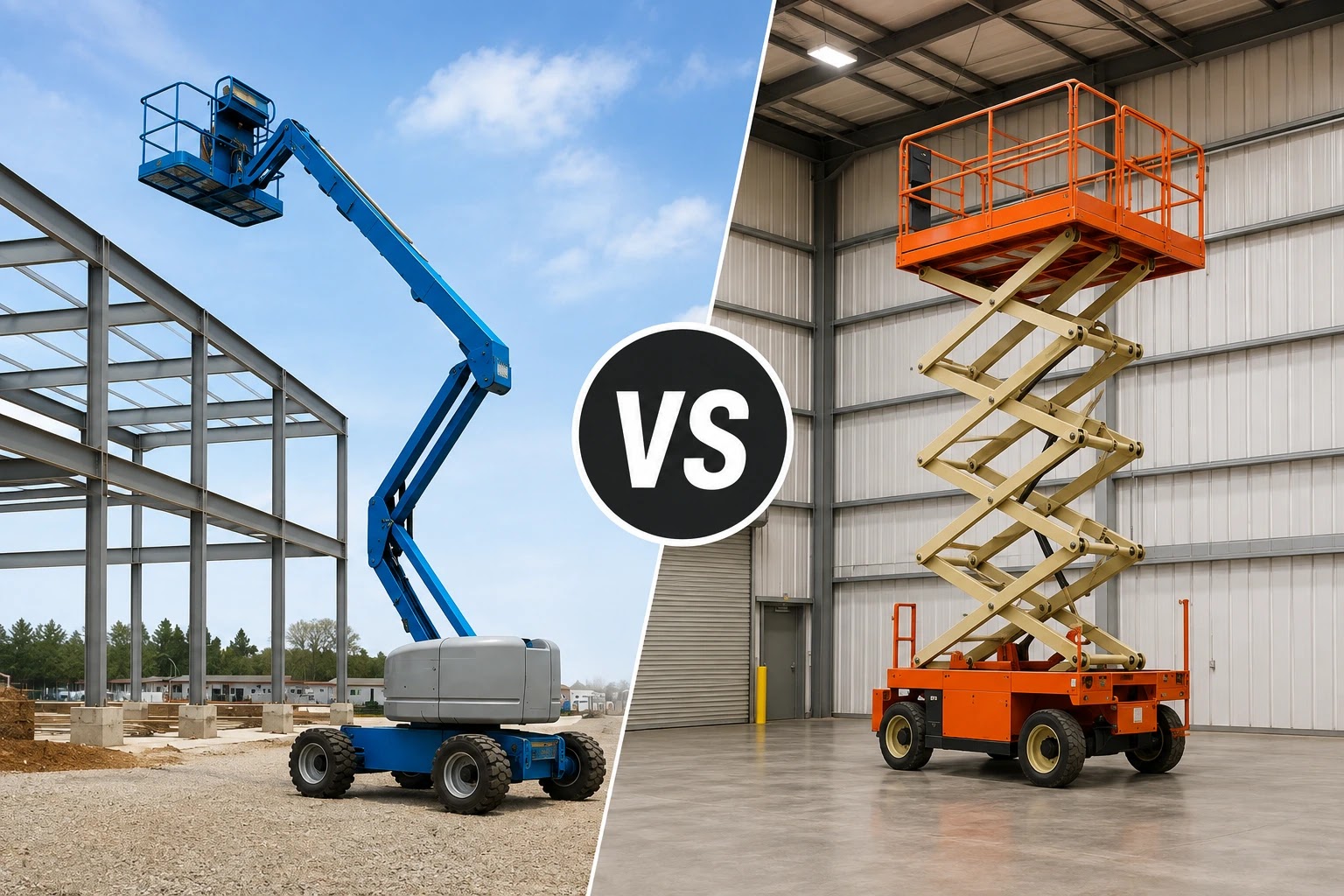
Boom Lift and Scissor Lift on Dubai Construction Site
Technical Specification Comparison Matrix
| Feature / Parameter | Boom Lift | Scissor Lift |
|---|---|---|
| Reach direction | Outward and upward | Straight up only |
| Platform over obstacles | Yes | No |
| Platform size | Small — typically 1 person | Larger — 2 or more workers |
| Max working height | 10m to 55m+ | 6m to 18m+ |
| Ground type (outdoor) | Rough terrain 4x4 diesel | Rough terrain diesel models |
| Ground type (indoor) | Electric models | Electric models |
| Stability for sustained work | Good | Excellent |
| Repositioning speed | Fast — operator-controlled | Fast on flat surfaces |
| Typical daily rate | Higher | Lower |
How a Boom Lift Works
A boom lift uses an extendable arm — the boom — to position a working platform at height. The boom articulates, telescopes, or both, allowing the platform to be positioned outward from the machine's base as well as upward. This means a boom lift can reach horizontally over walls, fences, existing structures, and other obstacles to position the platform precisely at the work zone.
The operator controls both ground movement and boom position from inside the platform. This makes boom lifts self-contained and highly flexible for positioning work.
There are two main boom configurations:
Telescopic (straight) boom — extends in a straight line for maximum horizontal reach from a single ground position. Best where the path between machine and work zone is clear and unobstructed.
Articulated (knuckle) boom — has jointed sections that bend, allowing the platform to reach up and then over obstacles. Best for sites with walls, parked vehicles, existing structures, or other ground-level obstructions between the machine and the work area.
Both types are available in diesel 4x4 for outdoor sites and electric for indoor environments.
How a Scissor Lift Works
A scissor lift raises its platform straight up and down using a series of folding cross-braced supports — the scissor mechanism. The platform moves only vertically, directly above the machine's base. It cannot reach sideways or over obstacles.
The scissor lift's platform is typically much larger than a boom lift platform, and it can carry more weight — often two or more workers plus tools and materials simultaneously. This makes it a more stable and productive working environment for sustained work at a fixed height.
Scissor lifts come in two main power variants:
Electric — zero exhaust emissions, quiet operation, suitable for all indoor environments including warehouses, shopping malls, hospitals, and finished commercial interiors.
Diesel / rough terrain — for outdoor construction sites and any unpaved or uneven ground where the electric model's smooth tyres would lose traction.
The Core Difference — Reach Direction
This is the single most important distinction between the two machines:
A boom lift reaches outward and upward. It can position the platform at a point that is not directly above the machine's ground position.
A scissor lift reaches only upward. The platform can only be at a point directly above the machine's ground position.
Everything else — cost, platform size, machine dimensions, suitable terrain — follows from this fundamental difference.
If the work zone is not directly above the machine's ground position, or if there is anything between the machine and the work area, a boom lift is required. If the work zone is directly overhead and the surface below is flat and stable, a scissor lift is typically the better choice.
When to Choose a Boom Lift in Dubai
Use a boom lift when:
There are obstacles between the machine and the work zone. A wall, fence, parked vehicle, road barrier, or existing structure between the machine's ground position and the work area means only a boom lift can reach the work zone without the machine being directly beneath it.
The work point is not directly above any accessible ground position. Building facades set back from a road, work areas over a void or pit, or access points that require the platform to reach over a structure all require a boom lift.
You are working on an outdoor construction site with uneven terrain. Diesel 4x4 boom lifts handle sand, gravel, and rough ground where wheeled machines struggle. Telescopic boom lifts are standard for facade work, steel erection, and MEP installation on Dubai's active construction sites.
The height required exceeds what scissor lifts offer. For working heights above 14 to 18 metres on a construction site, a telescopic or articulated boom lift is the practical choice.
Common Dubai applications for boom lifts include building facade maintenance and cladding installation, outdoor construction site elevated access, exterior painting and rendering at height, rooftop MEP equipment installation, and large outdoor event lighting and rigging.
When to Choose a Scissor Lift in Dubai
Use a scissor lift when:
The work zone is directly above the machine's ground position. Ceiling maintenance, overhead MEP installation, suspended ceiling systems, light fitting replacement, and sprinkler inspection are all directly overhead tasks that a scissor lift handles efficiently.
Multiple workers need to share the platform. Scissor lift platforms carry two or more workers plus tools and materials. For work requiring a team — installing a suspended ceiling or working on a large overhead area — the scissor lift's wider platform is far more productive than a boom lift.
The surface below is flat and stable. Electric scissor lifts are designed for smooth, flat floors — warehouses, shopping malls, finished offices, and hotel interiors. They should not be used on rough, uneven, or sloped ground unless a rough terrain diesel model is specified.
You are working indoors in an occupied building. Electric scissor lifts produce zero exhaust emissions and low noise. They are the standard FM maintenance machine across Dubai's commercial towers, retail centres, and hotels.
Cost efficiency matters for sustained, stationary work. Scissor lifts are typically lower cost per day than equivalent boom lifts. For work that stays in one overhead position for extended periods, the scissor lift is more economical.
Common Dubai applications for scissor lifts include warehouse racking installation and maintenance, retail and shopping mall light fitting and AC servicing, hotel and commercial building FM maintenance, interior fit-out and MEP rough-in on construction sites, and industrial facility overhead maintenance.
Special Consideration: Dubai's Indoor Environments
Dubai has an unusually large stock of high-specification commercial buildings — hotels, malls, mixed-use towers, and corporate offices — where indoor aerial platform use is common and the indoor environment is often fully finished and occupied. This makes the electric vs diesel decision particularly important.
In any enclosed or partially enclosed indoor space in Dubai, use electric models only — both boom lifts and scissor lifts. Diesel exhaust in an enclosed space creates health and safety risks, potential damage to finished surfaces, and violates building management requirements across most commercial properties in Dubai.
For indoor work in occupied hotels or malls, additionally consider the noise output. Electric scissor lifts are significantly quieter than diesel alternatives and cause less disruption to ongoing building operations.
A Simple Decision Framework
Answer these four questions in order:
1. Is there anything between the machine's ground position and the work zone? Yes → Boom lift required. No → Continue to question 2.
2. Is the work zone directly above an accessible ground position? Yes → Scissor lift may be suitable. Continue to question 3. No → Boom lift required.
3. Is the surface below flat, stable, and level? Yes (indoor, paved) → Electric scissor lift. No (outdoor, rough) → Diesel or rough terrain scissor lift.
4. Do multiple workers need to share the platform? Yes → Scissor lift (larger platform). No → Either machine may work — let height and reach requirements decide.
Common Mistakes When Choosing Between the Two in Dubai
Choosing a scissor lift for an obstructed site. If the work area requires reaching over a wall, bollard, parked car, or existing structure — a scissor lift physically cannot reach it. This is the most common reason for the wrong machine arriving on site.
Using a diesel boom lift or scissor lift indoors. Diesel exhaust in enclosed spaces is a health and safety issue. All indoor aerial platform work in Dubai's commercial buildings requires electric models.
Underspecifying working height. The working height of an aerial platform is measured to the platform guard rail top — the operator actually works slightly below this. When selecting a machine, confirm the height to the actual work point, not the manufacturer's stated working height.
Ignoring ground conditions. A standard electric scissor lift on an unpaved construction site is unsafe. Always specify the ground type — indoor smooth floor, outdoor paved, or outdoor rough terrain — when requesting equipment.
Conclusion & Project Recommendation
The boom lift vs scissor lift choice comes down to one practical question: is the work zone directly above the machine, or does the platform need to reach outward to access it? Directly above — scissor lift. Outward reach required — boom lift. Indoor — electric. Outdoor rough terrain — diesel.
For most construction site work in Dubai, boom lifts are the more flexible choice. For sustained overhead work in warehouses, malls, and commercial towers, scissor lifts are the more productive and cost-effective solution.
For more detail on each machine type, specifications, and availability across Dubai, see our dedicated boom lift rental Dubai and scissor lift rental Dubai pages. For a full overview of aerial work platform types available in the UAE, visit our aerial work platform rental Dubai guide.
Related Equipment Services (Direct Internal Pages)
Require Equipment on Site in Dubai?
Get mobile cranes, boom lifts, scissor lifts, or forklifts delivered to your job site within 2 to 4 hours.
More Equipment Guides & Comparisons
View All Archives →Mobile Crane vs Tower Crane in Dubai: Which Is Right for Your Construction Project?
Choosing between a mobile crane and tower crane for your Dubai project? This guide explains the key differences, when each type is used, and how to decide.
Read Guide →JCB Backhoe Loader vs Excavator: Selecting Earthmoving Machinery in Dubai
Detailed earthmoving comparison between JCB 3CX/4CX backhoe loaders and hydraulic excavators for construction contractors in Dubai.
Read Guide →Telehandler vs Forklift: Which Material Handling Machine Suits Your Dubai Site?
Compare telehandlers and industrial forklifts for warehouse logistics, outdoor construction yards, and material placement in Dubai.
Read Guide →Boom Loader vs Wheel Loader: Material Movement Efficiency in UAE
Technical comparison between telescopic boom loaders and heavy wheel loaders for aggregate handling and site stockpiling in Dubai.
Read Guide →