Mobile Crane vs Tower Crane in Dubai: Which Is Right for Your Construction Project?
Every construction project that requires lifting faces the same early decision: which type of crane? In Dubai's high-rise dominated skyline and fast-moving construction environment, the choice between a mobile crane and a tower crane comes up on almost every medium to large project. The two cranes are fundamentally different machines with different deployment models, cost structures, and suitability profiles. Choosing wrong costs time and money. This guide explains both types clearly and gives you the framework to make the right decision for your specific project.
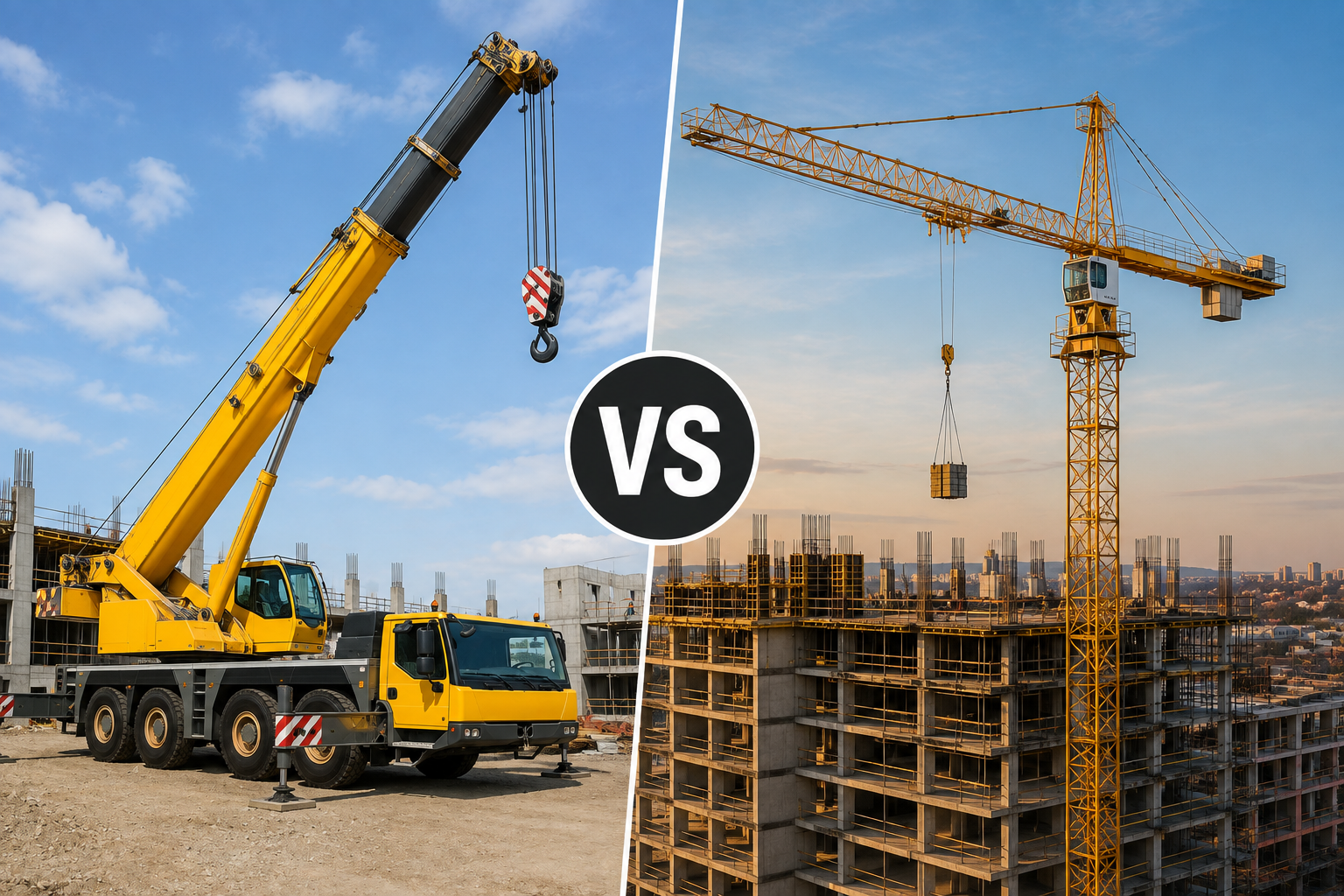
Mobile Crane vs Tower Crane on Dubai Construction Site
Technical Specification Comparison Matrix
| Feature / Parameter | Mobile Crane | Tower Crane |
|---|---|---|
| Mobility | Self-propelled, road-legal | Fixed — stays on site |
| Setup time | Hours | Weeks (including foundation) |
| Duration suitability | Short to medium term | Long term — months |
| Max hook height | Typically 50m–70m (standard) | Project-dependent, can exceed 100m |
| Daily lifting coverage | Requires repositioning per lift zone | Continuous 360° overhead coverage |
| Ground requirement | Firm, level ground for outriggers | Concrete foundation required |
| Lead time (Dubai) | 24–48 hours | 2–4 weeks minimum |
| Best for | Occasional lifts, multi-position, short projects | High-volume, long-duration, high-rise |
| Cost model | Day rate | Monthly rental + erection + dismantling |
What Is a Mobile Crane?
A mobile crane is a self-propelled crane mounted on a wheeled carrier — either an all-terrain carrier or a standard truck chassis. It can drive to the job site under its own power, set up in hours, perform the required lifts, and leave when the work is done. Mobile cranes require no foundation preparation, no installation crew, and no dismantling at project end.
The term "mobile crane" covers several machine types — all-terrain cranes, truck-mounted cranes, and rough terrain cranes — but they share the defining characteristic of being wheeled and road-mobile. In Dubai's market, all-terrain mobile cranes are the most commonly rented type for construction work, ranging from 20 ton to 130 ton and above.
The mobile crane's defining advantages: • Fast to deploy — on site and lifting within hours of arrival • Relocatable — can be repositioned within a site or moved to another project the same day • No site preparation required — no foundation, no erection crew • Available on short notice — typically confirmable within 24 to 48 hours in Dubai
The mobile crane's limitations: • Cannot lift as high as a tower crane without special configurations • Cannot maintain a fixed overhead lifting position for months at a time economically • Requires stable, level ground with adequate bearing capacity for outrigger deployment • Each lift requires the machine to be set up in position — no continuous overhead coverage
What Is a Tower Crane?
A tower crane is a fixed lifting machine anchored to a concrete foundation on the building site. It consists of a vertical mast, a horizontal jib (the arm that extends over the building footprint), a counterweight jib on the opposite side, and an operator cab at the top. The upper structure rotates a full 360 degrees around the mast, giving continuous coverage of the full building footprint from above.
Tower cranes are installed at the start of a construction project and remain on site until the building structure is sufficiently complete — often for months or over a year on high-rise projects. They are not designed to move between locations. Erection requires a mobile crane to assemble the tower, and dismantling requires the same process in reverse.
The tower crane's defining advantages: • Permanent overhead coverage of the full building footprint for the project duration • Can be climbed (raised) as the building rises, maintaining working reach throughout construction • Efficient for high-volume daily lifting on busy construction sites • Ideal for high-rise construction where loads need to be lifted consistently to great height • Lower daily cost per lift when deployed over months on a high-production site
The tower crane's limitations: • Requires advance planning, foundation preparation, and erection crew • Cannot be redeployed quickly — it stays where it is installed • Higher upfront setup and dismantling cost • Longer lead time — minimum two to four weeks from booking to operational
When to Choose a Mobile Crane in Dubai
A mobile crane is the right choice when:
• The project duration is short. If you need crane capability for days or weeks rather than months, the economics favour a mobile crane. The setup and dismantling costs of a tower crane — which can run tens of thousands of AED — are not justified for short-duration projects.
• Lifts are needed at multiple positions across a site. Mobile cranes can reposition between lifts, making them efficient when crane coverage is needed at different points rather than from a single fixed overhead position.
• Speed of deployment is critical. A mobile crane can be on site and lifting within 24 to 48 hours of booking in Dubai. A tower crane needs minimum two to four weeks from booking to operational — including foundation preparation and erection.
• The building height is within practical mobile crane reach. For structures up to 10 to 15 storeys, a large mobile crane can typically reach the required hook height without requiring a tower crane installation.
• Occasional heavy lifts are required on an otherwise complete site. MEP equipment placement, post-construction plant installation, and maintenance lifts on completed buildings are classic mobile crane applications where a tower crane makes no sense.
Common Dubai mobile crane applications include: steel structure erection on industrial buildings, precast concrete panel installation, MEP equipment placement on rooftops, short-duration construction site craning, and maintenance lifts at industrial facilities in Jebel Ali and Al Quoz.
When to Choose a Tower Crane in Dubai
A tower crane is the right choice when:
• The project is a high-rise building under continuous construction. Dubai's residential and commercial tower sector is the primary domain for tower cranes. Once installed, the tower crane provides daily continuous lifting capability across the full building footprint — far more efficient than repeatedly repositioning a mobile crane on a busy multi-storey construction site.
• The building exceeds practical mobile crane hook height. For buildings rising beyond 15 to 20 storeys, mobile crane hook height limitations make tower cranes the only practical option. Tower cranes are climbed as the building rises, maintaining lifting reach throughout the construction cycle.
• The project timeline justifies the setup cost. Tower crane erection and dismantling cost is significant but is spread across a long project duration. For a 12-month construction project, the amortised setup cost per month is manageable. For a three-week project, it is not.
• Multiple tower cranes need to operate simultaneously. On Dubai's mega-developments and large high-rise plots, multiple tower cranes operate simultaneously — flat-top (luffing jib) cranes are specified for these sites because their jibs can pass under each other as they rotate. Mobile cranes cannot achieve this coordination.
• The site is in a dense urban area with restricted access. Business Bay, Downtown Dubai, and DIFC plots surrounded by completed buildings often cannot accommodate the outrigger spread of a large mobile crane. A tower crane installed on the plot foundation sidesteps this constraint.
The Hybrid Approach — Using Both on the Same Project
Many Dubai construction projects use both mobile cranes and tower cranes at different stages:
• Tower crane erection requires a mobile crane to assemble it. The mobile crane arrives, erects the tower crane, and leaves. This is one of the most common mobile crane applications in Dubai's busy construction sector.
• Base-level material delivery during high-rise construction is often handled by telehandlers and smaller mobile cranes while the tower crane handles structural steel and heavy loads at height. This keeps the tower crane focused on high-value lifts.
• Tower crane dismantling at project completion again requires a mobile crane — often a large capacity machine — to disassemble the tower crane from the completed building.
Understanding this relationship helps project managers plan crane requirements across the full project timeline rather than treating mobile and tower cranes as alternatives.
A Simple Decision Framework for Dubai Projects
Use a mobile crane if: • Project duration is less than 6 weeks • Lifts are at different positions across the site • You need the crane operational within days • Building height is under 15 storeys • The job is a one-off heavy lift or maintenance lift
Use a tower crane if: • Project duration is 3 months or more • Building rises above 15 storeys • Daily high-volume lifting from a fixed overhead position is required • The site is a confined urban Dubai plot where mobile crane outriggers cannot spread safely • Project specification or developer requirement mandates it
Use both if: • You are building a high-rise and need a mobile crane to erect your tower crane • Different project phases have different crane requirements
Conclusion & Project Recommendation
The mobile crane vs tower crane decision is ultimately driven by project duration, building height, and lifting frequency. Short, flexible, multi-position work — mobile crane. Long, high-rise, high-volume daily lifting — tower crane.
For detailed specifications, capacity charts, and the full range of crane types available for projects in Dubai, see our mobile crane rental Dubai, tower crane rental Dubai, and crane rental Dubai pages.
Related Equipment Services (Direct Internal Pages)
Require Equipment on Site in Dubai?
Get mobile cranes, boom lifts, scissor lifts, or forklifts delivered to your job site within 2 to 4 hours.
More Equipment Guides & Comparisons
View All Archives →Boom Lift vs Scissor Lift in Dubai: Which Machine Is Right for Your Job?
Not sure whether to use a boom lift or scissor lift for your Dubai project? This guide explains the key differences, use cases, and how to choose the right machine.
Read Guide →JCB Backhoe Loader vs Excavator: Selecting Earthmoving Machinery in Dubai
Detailed earthmoving comparison between JCB 3CX/4CX backhoe loaders and hydraulic excavators for construction contractors in Dubai.
Read Guide →Telehandler vs Forklift: Which Material Handling Machine Suits Your Dubai Site?
Compare telehandlers and industrial forklifts for warehouse logistics, outdoor construction yards, and material placement in Dubai.
Read Guide →Boom Loader vs Wheel Loader: Material Movement Efficiency in UAE
Technical comparison between telescopic boom loaders and heavy wheel loaders for aggregate handling and site stockpiling in Dubai.
Read Guide →